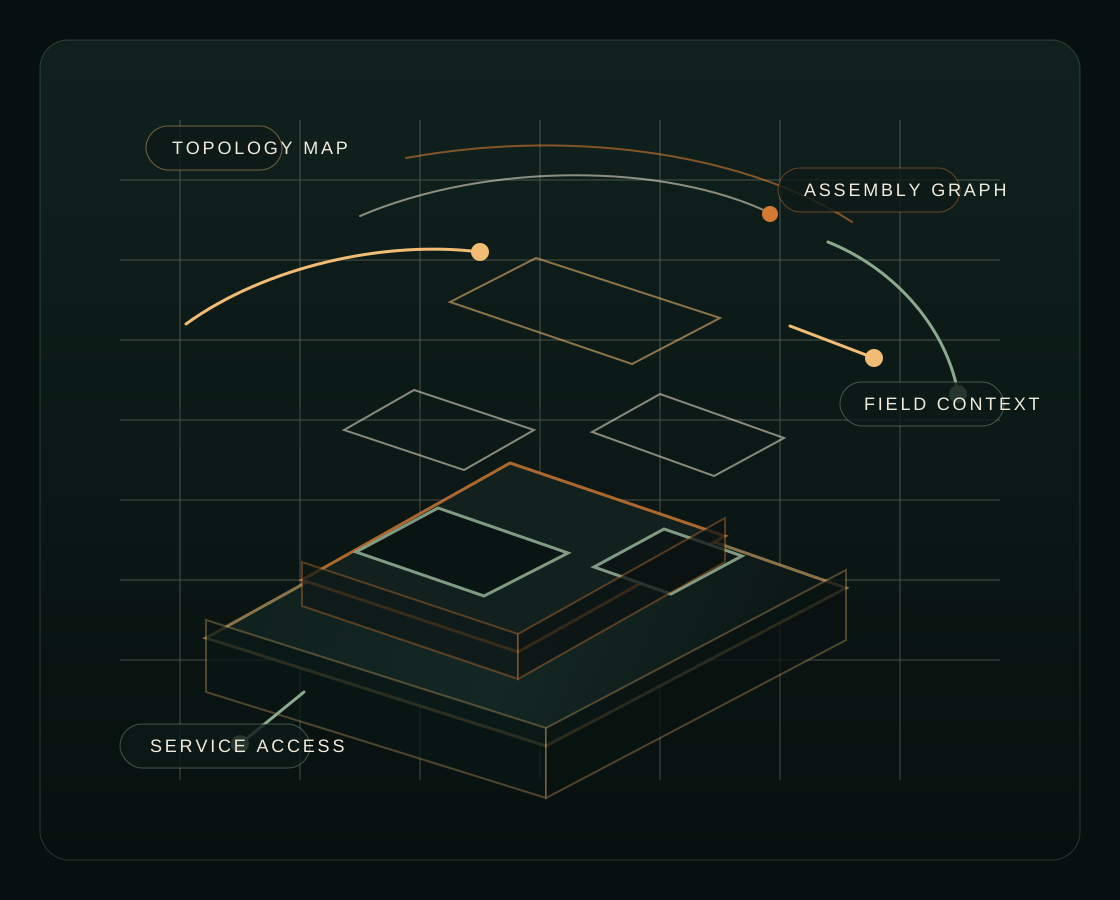
Geometry becomes searchable reasoning context
Ask about surfaces, clearances, interfaces, envelope limits, or components without flattening the model into a document summary.
For manufacturing, agriculture, robotics, and design-heavy product teams
Move beyond text-only copilots. Give your teams answers grounded in assemblies, geometry, adjacency, and spatial intent so design, operations, and service decisions stay tied to the real product.
Why spatial context matters
Traditional AI reads filenames, notes, and fragments of text. Spatially-aware AI reads how the product is actually assembled, constrained, and used in the real world.
Ask about surfaces, clearances, interfaces, envelope limits, or components without flattening the model into a document summary.
Keep part relationships, nesting, adjacency, and product structure intact so the model can reason with system-level awareness.
Turn engineering context into faster quoting, review cycles, service prep, automation planning, and design-risk visibility.
The context layer
Solids, surfaces, pockets, interfaces
Assembly hierarchy, adjacency, motion constraints
Functional zones, maintenance access, manufacturability cues
Answers you can route into engineering and operations
Scroll the workflow
Each stage adds more grounded context instead of hiding the geometry behind a text abstraction.
01
Ingest native CAD, drawings, and associated metadata without throwing away topology, dimensions, or assembly membership.
02
Retain mating surfaces, adjacency, joint movement, and part dependencies so the model reasons at the system level.
03
Map surfaces and assemblies to maintenance zones, manufacturing constraints, robotic reach, or agronomic equipment behavior.
04
Support design review, quoting, work instructions, and executive planning with reasoning that can be traced back to the model itself.
Where it lands
Manufacturing
Help product, operations, and sourcing teams reason over tooling, serviceability, part substitutions, and design review bottlenecks with geometry still in view.
Agriculture
Connect implements, service assemblies, and field equipment logic so teams can move faster on maintenance planning, documentation, and product support.
Robotics
Ground AI responses in reach envelopes, collision-sensitive zones, actuator relationships, and packaging constraints across complex electromechanical systems.
Executive teams
Turn CAD intelligence into faster diligence, clearer design-risk conversations, and better visibility into how engineering context affects delivery and margins.
Start with one workflow
A strong first pilot usually starts with a design review bottleneck, a service documentation gap, or a quoting workflow where spatial awareness changes the quality of the answer.